
ACTS 17- Being A Berean
Acts 17 takes us on a journey along the Egnatian Way, a major Roman highway that connected key cities across Macedonia. Philippi, Amphipolis, Apollonia, and Thessalonica lined this route, each separated by about a day’s walk. When Paul arrived in Thessalonica, Scripture says he reasoned with the Jews for “three Sabbath days,” but his ministry there likely extended well beyond that short window, as his letters later reflect.
In the synagogue, Paul opened the Scriptures and taught that “it was necessary for the Christ to suffer and to rise from the dead” (Acts 17:3). This was not a new idea. The Old Testament had always made it clear — Psalm 22, Isaiah 53, and the prophecies of Zechariah all pointed to a suffering Messiah. Yet the people struggled to reconcile a victorious Savior with the image of a rejected Servant. Even so, some Jews believed, and many God-fearing Greeks embraced the message. Scripture even highlights that prominent women were part of those who received the gospel, showing that the early church cut across gender, class, and culture.
But the same message that softened some hearts hardened others. As the crowds grew, the Jews who rejected Paul’s teaching grew jealous. They were losing influence, losing control, and losing the crowd. Jealousy always reacts with hostility. They stirred up trouble in the city, forcing Paul to leave and travel nearly fifty miles to Berea.
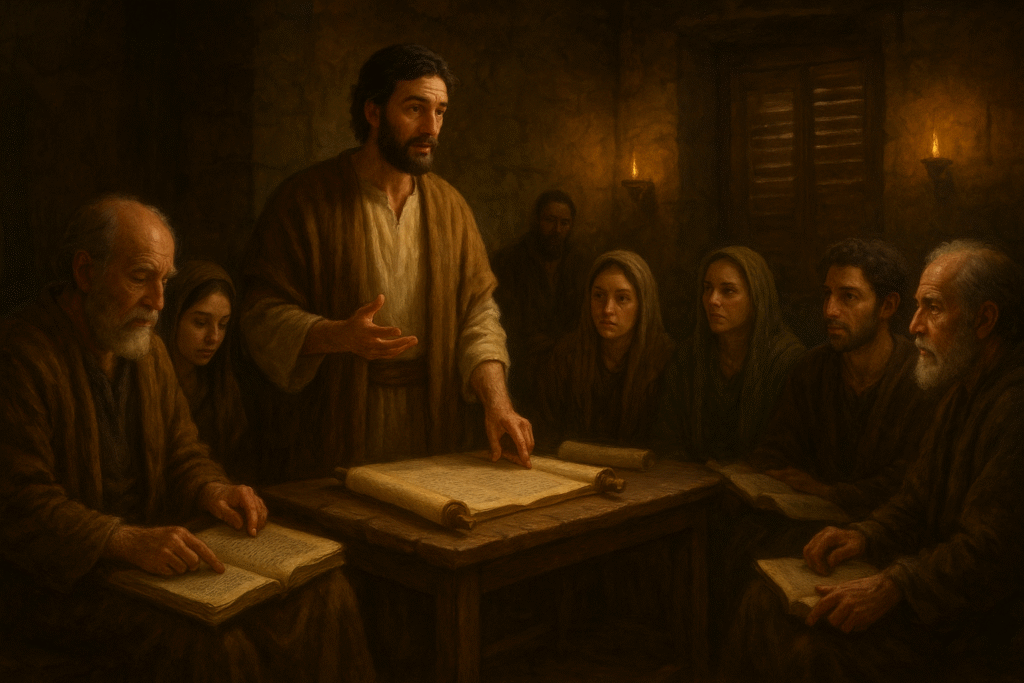
The Bereans, however, were different. They were described as “noble,” not in status alone but in spirit. They listened with openness, and they examined the Scriptures daily to see whether Paul’s teaching was true. They did not accept the word blindly and they did not reject it blindly. They tested it against what God had already spoken. That posture invited revelation. That hunger attracted the Holy Spirit. Many of them believed.
This challenges us today. God honours a heart that searches. Not a heart that is suspicious but a heart that is sincere, humble, and eager to know Him. The Bereans remind us that we cannot live on borrowed truth. We must examine the Scriptures ourselves and depend on the Spirit to give us understanding.
In time, the same opposition that pushed Paul out of Thessalonica found its way to Berea. Paul was escorted away while Silas and Timothy remained. Their paths branched for a time, Paul went on to Athens, and from there to Corinth, while Silas and Timothy brought updates and encouragement to the churches Paul had planted.
Athens stood as a center of culture, philosophy, and religion. Its skyline was filled with temples and idols, including the towering Parthenon. Yet beneath its sophistication was deep spiritual confusion. When Paul walked through the city, “his spirit was provoked within him” (Acts 17:16) because everywhere he turned he saw altars dedicated to powerless gods.
There was a Jewish community there, and there were devout seekers, but Paul’s ministry in Athens looked different. There were no recorded miracles. No large gatherings. No church formed. He stood alone, yet he stood boldly.
He reasoned with Stoic and Epicurean philosophers, and they brought him to the Areopagus, the council seat where ideas were weighed and judged. Standing before intellectual giants, Paul did what only the Holy Spirit can empower someone to do: he built a bridge.
He pointed to an altar inscribed “To the unknown god.”
And he declared that the God they did not know was the God who made the world.
Paul taught them that God is the Creator who does not live in temples and cannot be shaped by human crafts. He told them that God made every nation from one man, Adam, confronting any pride or racism subtly woven into their worldview. He said God created humanity so that we would seek Him, and even “feel our way toward Him,” though He is never far.
Paul even quoted their own poets, saying, “In Him we live and move and have our being,” and “we are His offspring.” Not to affirm their philosophy, but to reveal the truth buried beneath it.
Then Paul moved from the familiar to the eternal — from their poetry to Christ.
He declared that God once overlooked ignorance, but now calls all people to repent because a day of judgment is fixed. The proof of this coming judgment is the resurrection of Jesus.
Some mocked. Some hesitated. Some believed.
And that is the nature of the gospel.
It never leaves people neutral.
Acts 17 shows us that the message of Christ meets people in different conditions — jealousy in Thessalonica, hunger in Berea, and philosophical confusion in Athens. But no matter the soil, the seed remains the same, and the Spirit gives the growth.
Prayer
Father, thank You for the example of Paul who carried the gospel with courage into every environment—hostile, curious, and confused. Give me the heart of a seeker like the Bereans. Make me hungry for Your word and quick to examine whatever I hear in the light of Scripture. Help me stand confidently in places where faith seems strange and truth seems foreign. Teach me to build bridges, speak with wisdom, and trust the Holy Spirit to open hearts. Let my life be a witness that You are not far from any of us. In Jesus’ name, Amen.