
Acts 26- Vindication
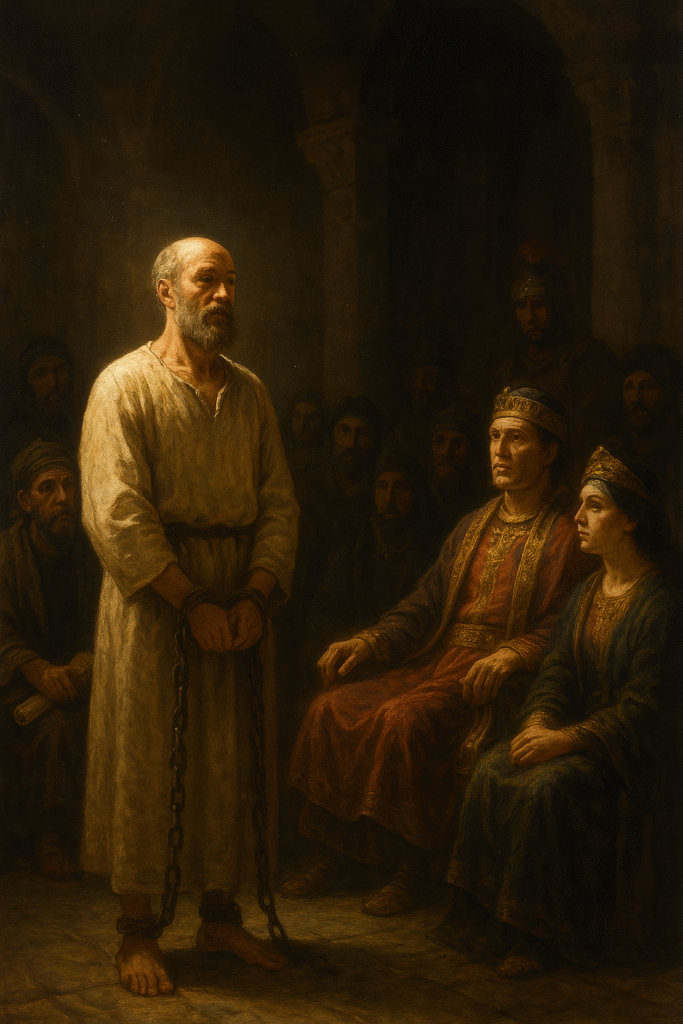
By the time we step into Acts 25–26, Paul has been held in Caesarea for over two years. Two years of waiting. Two years of uncertainty. Two years of knowing he had done nothing wrong and yet remaining behind Roman walls. And yet, Paul never lost the sense that even delayed seasons are divine assignments. God hadn’t paused Paul’s ministry. He had simply relocated it.
While in Caesarea, Paul was brought before three powerful figures: Governor Felix, Governor Festus, and King Agrippa II. Each hearing was an opportunity to witness. And in every room, Paul stepped in with a calm confidence that only the Holy Spirit can give.
Festus, the newly appointed governor, wanted to send Paul back to Jerusalem for trial, something that would have meant certain death (Acts 25:3). But Paul knew the Lord’s plan for him: Rome. So he exercised his right as a Roman citizen and appealed to Caesar (v. 11). This move not only protected his life but ensured the gospel would reach the highest levels of the empire.
Enter King Agrippa II, a man well-versed in Jewish law and prophecy. Paul’s defense before Agrippa is the longest and most detailed explanation of his conversion and the gospel in the entire Book of Acts (chapters 25–26). And Paul, as always, doesn’t sensationalize anything. He simply tells the truth of what Jesus did in him.
He shares how, on the road to Damascus, he heard Jesus say, “Saul, Saul, why are you persecuting Me? It is hard for you to kick against the goads.” (Acts 26:14). That phrase “kicking against the goads” was like saying, “You’re fighting the very God who is trying to lead you.” It’s a reminder that none of us outrun or outfight the grace of God. When He is after you, He will find you.
Paul goes on to explain that Jesus not only saved him, but commissioned him:
“…to open their eyes so that they may turn from darkness to light and from the power of Satan to God.” (Acts 26:18)
This is why Paul remained unwavering, even in chains. He knew his calling. He knew his purpose. He knew Who he belonged to.
And he reminds Agrippa and all of us that the gospel fulfills everything the prophets declared (vv. 22–23). The suffering of Jesus, His resurrection, and the call to repentance were not new ideas. They were the fulfillment of God’s ancient plan.
When Paul boldly asked Agrippa, “Do you believe the prophets? I know that you believe,” Agrippa tried to deflect:
“In a short time would you persuade me to be a Christian?” (v. 28)
But Paul, undeterred, replied with one of the most beautiful statements in Scripture:
“Whether short or long…I wish that all might become as I am—except for these chains.” (v. 29)
Paul didn’t want Agrippa’s political power, his palace, or his influence. He wanted Agrippa’s soul. He wanted him to know the joy, forgiveness, and freedom found in Christ.
And that is the heart of every true disciple: that others experience Jesus chains or no chains.
Even after the hearing, Agrippa declared that Paul was innocent (26:31–32). But because he had appealed to Caesar, he would go to Rome just as the Lord had said. What looked like injustice was actually divine positioning.
Acts 25–26 shows us that God wastes nothing, not delays, not trials, not injustice, and certainly not waiting seasons. Paul stood before governors and kings not as a victim but as a witness. His testimony reminds us that no earthly authority can derail God’s heavenly plan. And like Paul, we are called to share the light of Christ with boldness, clarity, and compassion even when our own story includes pain.
Prayer
Lord, thank You for Paul’s courage and the reminder that Your purpose prevails in every season, even the ones that feel slow or unfair. Give us the boldness to speak Your truth with grace. Help us to trust Your timing and to see every room we enter—whether small or influential—as a mission field. Strengthen our hearts so that, like Paul, we can say, “Whether short or long,” we desire that all might come to know You. Anchor us in Your will and steady us by Your Spirit. In Jesus’ name, amen.

